Research Finds That There Is One Decided Disadvantage to Cohabitation. What Is It?
The CDC's National Heart for Wellness Statistics (NCHS) put out a report in May on the demographics of cohabitation, with interesting contrasts among adults who are cohabiting, married, or neither. The report is based on a large, representative, national survey of U.S. adults aged eighteen to 44, sampled between 2011 and 2015. To acquit the analyses, the authors (Nugent and Daugherty) selected simply adults who had sexual intercourse with a partner of the opposite sex. They did that to ensure the groups were comparable in some respects regarding their histories in intimate relationships. The groups reflect those who were currently cohabiting, married, or neither at the fourth dimension of existence surveyed.
Cohabitation, Marriage, or Neither
The study shows that as of 2015:
- 17.1% of women and 15.9% of men were cohabiting
- 44.nine% of women and 43.five% of men were married
- 38.0% of women and 40.6% of men were single, and non cohabiting
This type of information does not address pathways over fourth dimension, such as how many among the current cohabiters will eventually marry or how many of those not currently residing with a partner volition somewhen exercise either or neither. However, at that place are estimates of the number of times people in the groups take cohabited outside of marriage upwards to the time they were surveyed.
Threescore-seven percent (67%) of those currently married had cohabited earlier marriage with one or more than partners.i Many of those currently single or not cohabiting had cohabited before. Fifty-1 (51.4%) of the women in that group had lived with one or more partners before, and 42.9% of the men had done likewise. Doing a little math, we gauge from the written report that 64.5% of the unabridged sample has cohabited with a romantic partner at some point outside of spousal relationship. That'southward not the percent of people sampled who will cohabit outside of marriage at some bespeak in their lives, though. The lifetime per centum for this group would, of form, be higher. To get that number, you'd have to follow everyone in the sample until each person had either cohabited or died. That could exist a long expect. (Information technology might be that Facebook could eventually tell us those numbers.)
The data on premarital cohabitation history in this sample volition be an under-guess because the marrieds make upwards a higher percentage of the older people in that age range, and there is every reason to believe that the youngest, non-marrieds in the sample are more probable to cohabit prior to marriage than those who are older. Other estimates not based on this specific report are that the percentage of people living together earlier tying the knot is at present at an all-time high of over 70%.2 We believe this figure will go college still. There remain some groups, peculiarly the more than traditionally religious,3 who will not live together before marriage, but otherwise, cohabitation is common and there is little stigma associated with it.
Thus, a very high percent of people in the U.Due south. conjugate outside of wedlock. It is now normative behavior. Wendy Manning has estimated that "[t]he percentage of women ages nineteen-44 who have always cohabited has increased by 82% over the past 23 years." For those aged 30-34 in 2009-2010, she has shown that 73% of women had already cohabited with someone. If yous combine such numbers with the fact that, every bit Susan Brown has shown, there is a steady increase in cohabitation amidst older adults (after the death of a spouse or divorce),iv it is easy to imagine that the number of people who will eventually conjugate exterior of marriage could reach 80% or more.
Cohabitation has profoundly increased in large measure because, while people are delaying marriage to ever greater ages, they are not delaying sex, living together, or childbearing. In fact, on the latter signal, Manning noted in her recent address to the Population Clan of America that almost all of the increment in non-marital births in the U.S. since 1980 has taken place in the context of cohabiting unions.
Cohabiting with more than ane partner outside of marriage has also gone steadily higher.5 The NCHS written report does not demonstrate the trend, only it does bear witness that 44% of the currently-cohabiting group and 20% of the neither cohabiting nor married group had already lived with two or morepartners. Ever higher levels of serial cohabitation mean that more people are on one of the pathways strongly associated with risks for family unit instability or divorce.6 Prior research has shown that series cohabitation is strongly associated with economic disadvantage among unmarried couples,vii lower odds of spousal relationship, and increased odds of poor marital outcomes, simply serial cohabitation is growing rapidly among different population groups.8
A very high percent of people in the U.Due south. cohabit outside of union. Information technology is at present normative behavior.
Increasing rates of cohabitation, equally well as serial cohabitation, might be of no special consequence except for the betoken noted above, that many births at present occur in cohabiting unions. Some percentage of these couples have a long-term commitment similar to marriage, only, on boilerplate, cohabiting parents are much more likely than married parents to intermission up,9 resulting in increasing odds of family instability for children. Much of this gamble is due to selection, a subject field we volition come to below.
Other Characteristics of these Groups
Other findings from the NCHS report are consistent with the manner that basic family unit patterns have increasingly diverged effectually cultural, educational, and economic lines. For example:
- 47.9% of cohabiting women had household incomes less than 150% of the federal poverty line, compared to 25.6% of married women
- 36.ane% of cohabiting men had incomes less than 150% of the federal poverty line, compared to 21.two% of married men
- 25.ii% of cohabiting women had incomes over 300% of the federal poverty line, compared to 48.one% of marrieds
- 32.4% of cohabiting men had incomes over 300% of the federal poverty line, compared to 52.4% of marrieds
This is i of the more hit examples of the fact that a lot of cohabiting women and men tend to be poor compared to married women and men. The information on education follow the aforementioned blueprint, of class. Married people had the most education followed by those who were not married or cohabiting, with cohabiting people reporting lower levels of education than the other 2 groups. For example:
- 25.3% of cohabiting women had a bachelor'due south degree, compared to 43% of married women
- xvi.2% of cohabiting men had a bachelor'south degree, compared to 36.v% of married men
While the educational activity levels of many of the cohabiters in this sample will become higher over time, the findings from many studies show that cohabitation (especially with cohabiting relationships non leading directly to spousal relationship) is associated with beingness more disadvantaged, on average.x The data are consistent with the story of a grade divide around marriage and cohabitation.11
Attitudes and Experiences
This NCHS report likewise presents differences in the 3 groups based on attitudes and experiences about unmarried sexual practice, cohabitation, and having children outside of marriage. Non surprisingly, both of the non-married groups are less traditional in their views than those who are married. These findings are reflected in the table below from the study.
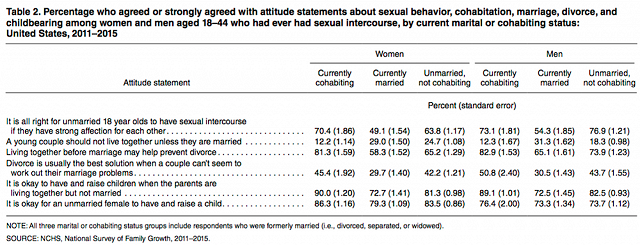
While there are clear differences, large majorities of every group believe that having and raising children without being married is fine; this is endorsed by the greatest number of cohabiters. Of course, that finding would have been quite different decades ago. Marrieds are the most disapproving of cohabitation outside of marriage, but even most of the married group agreed that it is all right to do so.
Majorities of every group as well believe that living together before marriage may help forestall divorce. This is of detail interest to united states of america given our research related to this question.12 The percentage assertive this was highest for those currently cohabiting.
This notion has had broad acceptance since at least the mid-1990s, when three-fifths of high school students believed that, "Information technology is normally a good thought for a couple to live together before getting married in club to discover out whether they really get along."xiii It is worth noting that at that place is virtually no evidence in back up of this conventionalities. However, it is also fair to note that there used to be a lot clearer bear witness to the contrary.
Regardless, we believe that in that location is considerable evidence that some patterns of living together earlier spousal relationship are associated with increased risks for less successful marriages. We do think experiences and choices matter for time to come outcomes. This exclamation is mildly controversial amongst those who study cohabitation. To be certain, there is a mountain of evidence for selection in both who cohabits and who volition cohabit in the riskier ways. What that means is that people who are already at greater risk for worse outcomes in relationships considering of things like family background, disadvantage, or individual vulnerabilities are also more likely to practice whatever of the post-obit: conjugate and not marry, cohabit before having articulate, mutual plans to marry, or cohabit with a number of dissimilar partners over time. There is plenty of show of other patterns in the NCHS report related to cohabiters beingness more select for various relationship risks. Consider the following findings.
Relationship Risks Associated with Cohabitation
Cohabiters were more than likely (74%) than those currently married (56%) to take had sexual intercourse earlier the age of 18. Cohabiting women were likewise more likely to report ever having an unintended nascency (43.5%) compared to married women (23.9%). These types of patterns are associated with life-long adventure factors already present in the lives of many people. Of course, you could fence that such differences besides reflect choices people make that have potentially causal, life-altering consequences. Such debates are endless, but nosotros do non dubiousness a huge role for selection in all of this. And yet, we believe at that place often are causal elements impacting life outcomes related to the feel of cohabitation.
Those who first cohabiting before deciding to marry report lower average marital quality and are more likely to divorce. This added risk is compounded past the fact that most couples slide into cohabiting rather than make a clear decision well-nigh what it means and what their futures may hold.
First, it has been shown that cumulative cohabiting experience changes peoples' beliefs well-nigh wedlock.14 While that research is older, the theory backside the research is compelling. Much enquiry shows nosotros learn from experiences and experiences change our behavior. We believe that the increase in cohabitation, serial cohabitation, and premarital cohabitation has led to consistent downward trends in the belief that marriage is special.
Second, cohabitation makes it harder to suspension upwardly, net of everything else. Because of the inertia of living together, some people get stuck longer than they otherwise would have in relationships they might have left or left sooner. In fact, we believe some people marry someone they would otherwise have left because cohabitation fabricated information technology too hard to motion on. Inertia should exist the greatest problem for couples who had not decided beforehand on their time to come, such equally by already having mutual plans to marry (due east.g., engagement) or, of course, past first marrying. While the increased chance can be modest, the prediction is consistently supported with at least vii reports using six dissimilar samples, showing that those who first cohabiting before deciding to marry report lower average marital quality and are more likely to divorce.15 This added gamble is compounded by the fact that almost couples slide into cohabiting rather than make a clear decision near what information technology means and what their futures may hold.sixteen
Tertiary, cohabitation is increasingly a context for childbearing. Since cohabiting parental unions are relatively unstable, the increasing number of couples who intermission up in such unions will mean more people inbound future relationships with the challenge of children in tow.
Prove of pick abounds merely then exercise reasons for assertive that experiences and personal choices are relevant to life outcomes.
Complexity Abounds
These e'er-changing patterns in human relationship and family unit development are complex, and they exercise not operate in the aforementioned way for all. For instance, there is research suggesting that cohabiting experiences may pb to more positive attitudes virtually wedlock amid young, African American adults. More broadly, as Sharon Sassler and Amanda Miller argue in Cohabitation Nation, there are various social form disparities that touch on things like if and how presently a person will motility in with a partner. Some pathways will lead to different sets of outcomes for different people, and some people accept more than power (economic and personal) to avert paths that increase the odds of poor outcomes.17
The extraordinary changes of the past 4 decades reflect how ordinary cohabitation has get. At that place is not a elementary story here, only an ever-unfolding one of increasingly complex families.
Scott Chiliad. Stanley is a research professor at the University of Denver and a fellow of the Institute for Family Studies (@DecideOrSlide). Galena G. Rhoades is a inquiry associate professor at the University of Denver.
ane. It cannot be determined from these data if this means that 67% would have cohabited before spousal relationship with their spouse, only presumably, that is a reasonable estimate for those doing so.
2. Hemez, P. & Manning, W. D. (2017). "Thirty years of modify in women's premarital cohabitation experience." Family Profiles, FP-17-05. Bowling Green, OH: National Heart for Family unit & Marriage Inquiry. That'southward for the United States, but the rates are similarly high in all industrialized nations. In a recent accost to the Population Association of America, I believe Manning put that number at around 75%.
iii. There is a dash here for this new report. The group that is excluded by the selection criteria (about having had sexual intercourse with someone of the opposite sexual activity) are those in that age range who take neither married nor had sexual intercourse up to this point in their lives. Because of that, the estimate of 67% living together before marriage for this detail age range at that point in history would be a petty high. We cannot say how high but do not doubt that the percent who volition live together before marriage of the current generation of immature adults is now over seventy%.
four. Brownish, S. L., Bulanda, J. R., & Lee, G. R. (2012). "Transitions into and out of cohabitation in later on life."Periodical of Matrimony & Family, 74(4), 774-793. doi:10.1111/j.1741-3737.2012.00994.x
5. This trend is noted in the NCHS report, just the report itself does non present information on that trend. The authors cite earlier studies on the increase in series cohabitation: Cohen J, & Manning W. (2010). "The relationship context of premarital serial cohabitation."Social Science Research, 39, 766 – 776.; Lichter, D. T., Turner, R.N., & Sassler S. (2010). "National estimates of the rise in serial cohabitation."Social Science Inquiry, 39, 754 – 765.
6. Lichter, D. T., Turner, R.North., & Sassler South. (2010). "National estimates of the rise in serial cohabitation."Social Science Research, 39, 754 – 765.
vii. Ibid Lichter et al. (2010); Lichter, D., & Qian, Z. (2008). "Serial cohabitation and the marital life form."Journal of Matrimony & Family, 70, 861-878.
8. Ibid Lichter et al. (2010).
9. "Only one out of 3 children born to cohabiting parents remains in a stable family through age 12, in dissimilarity to well-nigh three out of four children born to married parents;" Manning, Due west. D. (2015). "Cohabitation and kid well-being."The Future of Children, 25(2), 51–66; encounter besides McLanahan, S., & Beck, A. Due north. (2010). Parental relationships in fragile families. The Future of Children, 20(2), 17-37.; McLanahan, S., & Brook, A. N. (2010). "Parental relationships in frail families."The Futurity of Children, 20(2), 17-37.
10. It is important to annotation that this blazon of information too cannot distinguish between cohabiters who volition transition into marriage with their current (or a future) cohabiting partner and those who will not.
11. See for case: Smock, P., & Greenland, F.R. (2010). "Diversity in pathways to parenthood: Patterns, implications, and emerging enquiry directions."Journal of Marriage & Family, 72, 576-593.
12. If you want to dig in pretty deeply on theory and research from us on this subject field, you can showtime here or here, and notice summaries and links to many (non-gated) papers you tin can read if you similar.
xiii. Thornton, A., & Young-DeMarco, L. (2001). "Four decades of trends in attitudes toward family bug in the U.s.a.: The 1960s through the 1990s."Journal of Marriage & Family, 63, 1009-1037. doi:ten.1111/j.1741-3737.2001.01009.x
14. Axinn, Due west. G., and Hairdresser, J. Due south. (1997). "Living arrangements and family formation attitudes in early adulthood."Periodical of Marriage & Family 59, 595-611.
fifteen. In addition to the list of the body of studies on the spousal relationship-plans-timing result (partial list following, full listing here), a recent study shows that relationship quality is highest (on average) for marrieds and lowest for cohabiting couples without plans to marry, with marrieds who cohabited earlier wedlock and cohabiters who currently had plans in betwixt those two groups: Brown, S., Manning, Westward. D., & Payne, K. K. (2017). "Relationships quality among cohabiting versus married couples."Journal of Family unit Issues, 38, 1730 – 1753. (First appeared in advance online publication in 2015); Examples of studies with the engagement/plans timing issue: Kline, G. H., Stanley, S. M., Markman, H. J., Olmos-Gallo, P. A., St. Peters, M., Whitton, S. W., & Prado, L. (2004). "Timing is everything: Pre-engagement cohabitation and increased risk for poor marital outcomes."Journal of Family Psychology, 18, 311-318.; Rhoades, G. K., Stanley, S. Grand., & Markman, H. J. (2009). "The pre-engagement cohabitation effect: A replication and extension of previous findings." Journal of Family Psychology, 23, 107-111.; Stanley, S. Grand., Rhoades, Grand. Chiliad., Amato, P. R., Markman, H. J., & Johnson, C. A. (2010). "The timing of cohabitation and engagement: Impact on first and 2d marriages."Journal of Marriage & Family, 72, 906-918.
16. See Lindsay, J. Thousand. (2000, online version came out in 2014). "An ambiguous commitment: Moving into a cohabiting relationship."Journal of Family Studies, 6(1), 120-134.; Manning, Due west. D., & Smock, P. J. (2005). "Measuring and modeling cohabitation: New perspectives from qualitative data."Journal of Marriage & Family, 67,989 - 1002.; Stanley, S. 1000., Rhoades, G. K., & Fincham, F. D. (2011). "Understanding romantic relationships among emerging adults: The significant roles of cohabitation and ambiguity." In F. D. Fincham & Yard. Cui (Eds.), Romantic relationships in emerging machismo(pp. 234-251). New York: Cambridge University Press.
17. For instance: Sassler, South., Michelmore, K., & Qian, Z. (2018). "Transitions from sexual relationships into cohabitation and beyond."Demography, 55,511 - 534.
Source: https://ifstudies.org/blog/cohabitation-is-pervasive
0 Response to "Research Finds That There Is One Decided Disadvantage to Cohabitation. What Is It?"
Post a Comment